The Ship

The Ship
Picton Castle

Monday, January 5, 2015

Changes

In the fine print, like most businesses, there is a clause about reserving the right to make changes to the itinerary for various reasons.  They have taken advantage of this right and made several changes to the original list of places we were expecting to visit.  

The first changes we heard about from the captain.  Due to unrest in Madagascar we were not going to be able to stop there as planned and, due to the Agulhas Current we were not going to be able to reach Mozambique.  The Agulhas Current is pretty much just like the Gulf Stream in the Atlantic.  It’s a warm current the flows south between the East Coast of Africa and Madagascar.  It flows at up to about 4 knots and would be against us if we tried to go to Mozambique.  The next changes we actually heard about through a mass email sent out by the home office.  Due to Savannah, GA cancelling their participation in the Tall Ships festival in May we would not be ending the voyage there.  They had been exploring their options and ultimately decided to skip the US completely.  Now we are going to go to Bermuda around the 1 of May and from there we will be sailing to Lunenburg Nova Social, which happens to be the home of Windward Isles Sailing, the company that owns the ship.  The next change was announced by the captain at an all hands meeting a few days ago.  It seems that a lot of potential new trainees are indicating that they are not signing up due to concerns about Ebola in Africa.  The captain doesn’t seem to share the concerns but it’s affecting business so they have decided to take Senegal and Cape Verde off of the itinerary.  We are still planning on going to Namibia; however, they have indicated that if certain wind conditions exist, it may be necessary to forgo Namibia as well.  Evidently there is a strong wind that often blows from the south along the west coast of Africa and if it is blowing the ship will not be able to make the turn east to get into the port.  The new plan is to go straight from St Helena to the Caribbean, either to Grenada or Barbados.  This will give is more time to spend in the Caribbean and they have added Aruba.  Picton Castle has been invited to be the flagship of the tall ships festival in Aruba.  The rest of the Caribbean itinerary has been a bit vague as I guess the captain sort of makes it up as we go.


Some crew have pretty strong feelings about the changes and some may be leaving earlier than they originally had planned.  I don’t have really strong feelings but I am bummed about some of them.  I was really looking forward to seen Madagascar and all of the countries originally scheduled for Africa.  Savannah was a perfect jumping off point for me because my Mom and Dad were going to come and pick me up there, giving them the opportunity to see the ship and me the opportunity to spend some time with them after being away for so long.  I’m happy to go to Bermuda and Lunenburg.  I expect there will be a big to-do when we get in to Lunenburg since the ship has been out for 3 years.  Either way, I’m on board for sailing and gaining sea time, first and foremost, so I’m not letting the changes dampen my spirit at all.  Besides, this will make a bigger window of opportunity to be able to, maybe, meet up with some Lugnuts sailors in the Caribbean!

Passages


I believe I posted the first sunset I saw in Bali.  Here is the last sunset I saw in Bali
All of my sailing experience, before joining the crew of Picton Castle, has been on yachts in the 35 to 40 foot range.  This led me to have some expectations about what life at sea would be like aboard Picton Castle.  I have to say, I am a bit surprised about how much is different than expected. 
Sunset on the Inian Ocean
Watches
Distance racing on Lugnuts we have 2 watches, port and starboard, and we stand 4 hour watches with ‘dog watches’ in the afternoon.  The dog watches are two 2 hour watches, back to back, the purpose of which is to shift the watches so that the midnight watch rotates back and forth between port and starboard.  There are a lot of variations between watch schedules but I like the one we use on Lugnuts.  It can be a bit exhausting though because, at best one can only get about three and half hours of sleep at a time and often you’re lucky if you get that much.  Usually after the Mac race, which takes us about 3 days, I’m usually pretty worn out.  After the 5 day Bermuda race the exhaustion didn’t seem to be as bad.  We all thought that might have been because of having more time to adjust.  On Picton Castle we have 3 watches, with no dog watches.  This means instead of working 4 hours on and 4 hours off, we work 4 hours and then get 8 hours off.  Needless to say, this allows more time to sleep and do more leisure activities.  We’ve been at sea about 8 weeks now.  For the 4 weeks from Bali to Rodrigues I was on the 12-4 watch.  Between Rodrigues and Reunion the rotated the watches so I was on the 4-8 watch for one week.  When we left Reunion the shuffled the watches so we got new watch mates and officers; however, in the shuffle I ended up on 12-4 again.  Since we don’t have dog watches we have to stand the midnight watch every night…it seems I’m doomed to work the night shift whatever I do.  So, while I get more sleep that I would on a 2 watch schedule, I feel like I don’t get enough.  I have to sleep in split shifts or skip meals so I choose to sleep in split shifts.  It works fine but leaves me kind of tired much of the time.  Things will get shuffled again before we leave Cape Town so we’ll see what watch I get then.

Activity
Who is that sitting out on the end of the jib boom?  We had to un-bend the flying jib.  This was great fun, what can I say, I'm a bowman!  Photo credit:  Picton Castle
On the yachts we have pretty limited space to move around and, depending on conditions, moving around much can affect our performance.  If we’re not actually working most of our time is spent sitting on the rail waiting for the next tack or sail change.  This leads to a sailing specific ailment known aboard Lugnuts as “fiberglass ass”.  By the end of the 2013 Mac, when we were becalmed at the finish line for hours, my but was so sore that I refused to sit on the deck anymore and had to sit on a spinnaker bag.  On Picton Castle we have much more room to stretch our legs, which makes the long passages much more comfortable than I was expecting them to be.  We also have maintenance activities that we can participate in when we’re off watch, like rigging work, sail making or helping with carpentry projects.  I have volunteered for all of these and enjoy them all.

Sailing
This fiferail holds about 15% of the lines for main mast.  To the left is the scuttle that leads down to the solon, where my berth is.
I knew the sailing would be a lot different, after all, this is a barque that flies up to 10 square sails and 8 fore and aft sails (sails rigged along the center line of the ship, like a sloop).  We have many more lines to keep track of.  Each square sail has from 8 – 14 lines to control everything and the fore and aft sails have 5 each.  Another big difference is that Picton Castle doesn’t have any winches; mechanical aids to help with sail handling.  That means we used block and tackles or manpower against the weight of sails and rigging and the force of the wind.  Block and Tackle make for much longer lines and hoisting a sail like the upper topsail, which requires us to hoist the upper topsail yard as well, takes at least 5 people hoisting on the halyard.  The yard is steel and probably weighs around a ton and the sail probably weighs 80 lbs.  All of our sails are canvas and our line is manila.  Manila line has to be tended much more than modern lines.  It stretches under strain and shrinks when it gets wet so lines need to be adjusted frequently.  Lines and sails are also always at risk of failure as well.  So far we’ve had one headsail blow out when it was being taken in and one halyard parted when a sail was being set.  The biggest risk factor for both lines and sails is chafe.  Chafe is where lines or sails rub against each other or against spars or other parts of the ship.  We’re on constant lookout for chafe and add padding or bumpers or control lines to avoid chafe; all called chafe gear.

Helming (steering)
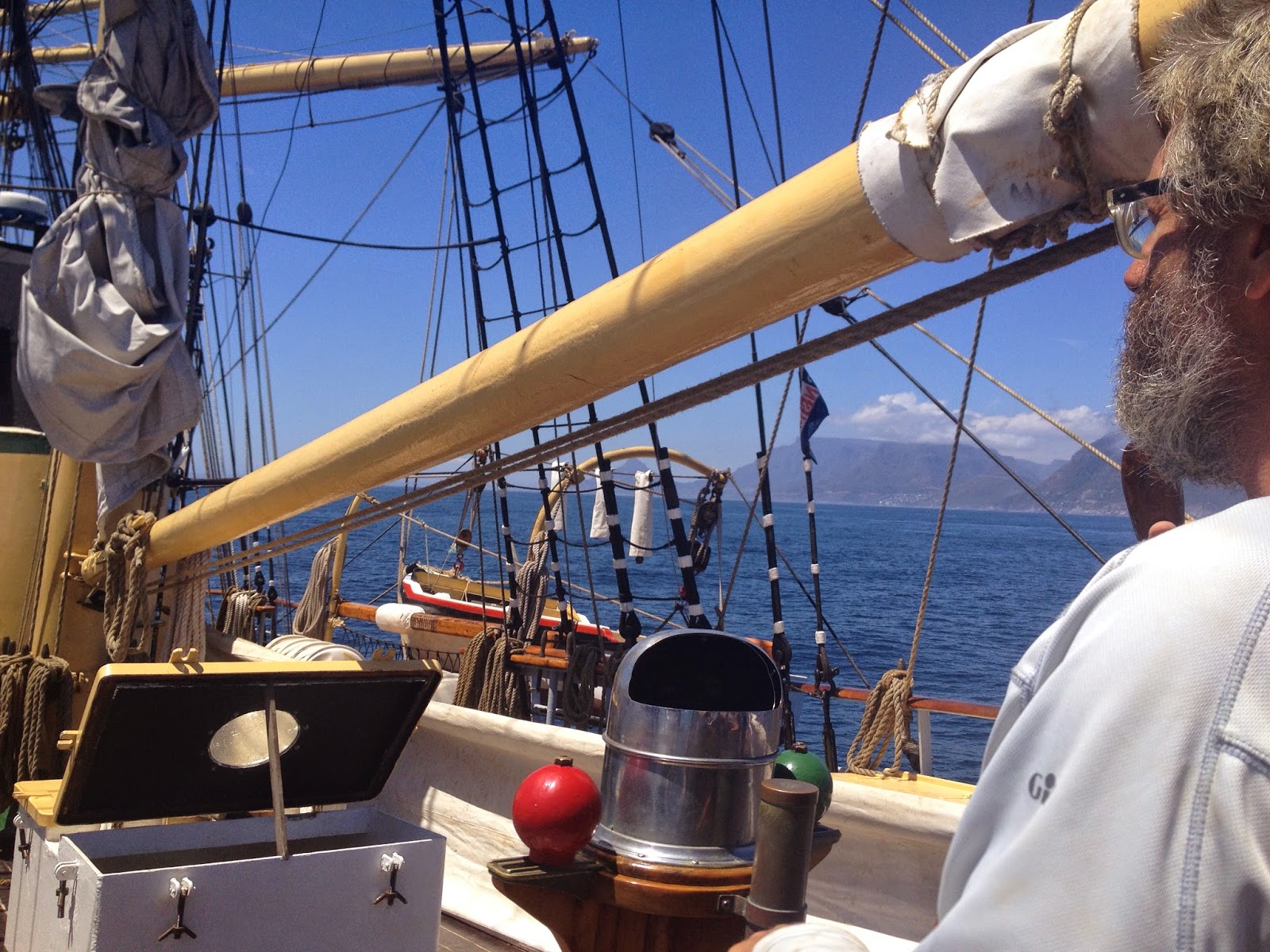
Helming on the way into Cape Town.  You can see Table Mountain under the boom.
Helming is one of the highlights of sailing, whether on yachts or on the ship.  On Lugnuts there is a little less than one full turn of the wheel to go from hard over to port, to hard over to starboard.  On Picton Castle it’s 20 turns of the wheel.  That has taken some getting used to; however, my confidence is growing on the helm.  We rotate 1 hour turns on the helm so, with 6 people on watch, one day I get one turn and the next day I get 2 turns.  The helm is on the quarter deck at the stern of the ship so it’s about 15 feet above the water and you’re looking down the length of the ship.  It’s open to the elements and had a great view.  It reacts much like a yacht as far as being pushed one way or another by wind and seas, it just takes more time and effort to respond.  Helming takes a lot of concentration to sail a good line but I just love it.
Sunrise one morning a couple days out from Reunion.  I caught this one on sheer luck.  I woke up to use the head (bathroom) just in time to see the sunrise.
This post was written at sea but we have now docked in Cape Town, which is the ending point of leg 2.  We sailed about 5,700 nautical miles on this leg and we got as far south as 35° 09’ South Latitude.  Of the 3 months allotted to the leg, we spent about 55 days at sea.  We had about 4 days of rain, not including some sprinkles at night between Bali and Rodrigues.

About 14 people are leaving at Cape Town and 6 new people have joined the ship, all but 2 of them have previous experience on tall ships.  As of now we’re scheduled to leave Cape Town on January 20th but that is subject to change.

Friday, December 12, 2014

Reunion


Approaching Reunion Island from the Northeast
Our passage from Rodrigues to Reunion had pretty light winds most of the way and we had to motor for about 16 hours to keep moving along.  We arrived in Reunion on Saturday, 12/6 on a lovely, sunny day.  Reunion is a roughly circular island with a diameter of about 36 miles.  It is part of France and has been since the late 16th century.  Being part of France allows the island to have first world infrastructure so they have great roads and lots of traffic.  The current population is around 900,000.  There is an active volcano in the Southeast so that area is not very populated.  The larger cities are around the coastal areas with many smaller villages scattered through the interior.  They seem to have some tourism, mostly from France but it's not a particularly easy island to get to.  Most of the tourist area is along the west coast.  The island is volcanic and at one time had a large number of volcanoes that have collapsed over the centuries, leaving a unique and remarkable landscape.  I've tried to get some photos but, once again, the pictures don't come close to the reality.  I have really enjoyed our week here and I'll be leaving tomorrow thinking that I will need to come back one day and finish exploring this amazing place.
From the sea you can get an idea of the mountainous nature of the island.  These raviens and hills are the defining features of the island and this is a very small example of one.  The towns are usually on the high ground with reviens on each side.
At the base of these cliffs is the highway that leads from Le Port to St Denni, which is the capitol.  It's a lovely drive and I imagine the homes on top have a great view.

This is the other end of that 8-10 kilometer long cliff on the East side of Le Port.  There are 2 ports here and we tied up in Port O'est (West).  There are no good natural harbors on the island so all of them are very nice man made ports that are very well protected from storms and high seas.
I went in with some shipmates and we rented 2 cars and drove up to a village in the interior called Cilaos.  As the crow flies the distance from the coast to Cilaos is about 8-10 kilometers but the road up the mountain is 36 kilometers and you can't go more than about 20 due to hairpin turns.  It took us a couple of hours to get there but we stopped a few times and took pictures.  Fortunately they drive on the right side of the road, which is good since I did all the driving.
Here is where we started to climb into the mountains.  The valley is very wide with a flat rocky bottom and there is a very small stream, maybe 10 feet wide, in the center.  We pretty much followed this valley all the way up.  The highest point on the island is a little over 3,000 meters, so a little over 10,000 feet.  That's quite a bit of altitude to cover from sea level at the cost to 3,000 meters in about 10 kilometers.
This should give you a sense of the road.  It was in excellent condition and quite steep.  The red sign you see is actually a bus stop.  Yes, they run busses up and down to all of the towns in the interior.  It costs 1.5 Euros to take the bus from the coast to Cilao.  Just to the right and on the outer edge of the turn you can see 2 posts.  This is a marked hicking trail that descends into the valley.  Reunion has hundreds of kilometers of improved hicking trails all over the island, many with cottages spaced a day's hike apart.  One trail makes a complete circle for over 100 kilometers and takes about 17 days to hike.
This is more than half way up the mountain at another bus stop.  Unfortunately the higher elevations are frequently shrouded in clouds but, if it were clear we would be able to see the sea in the center.

Steep, beautiful country.

This tunnel is about 300 meters long.  You're running along on the nice two lane mountain road and you turn into the tunnel enterence to find that the tunnel is only one lane wide and the inside of the tunnel is unfinished, bare rock.  They did put a wide spot in the middle so cars could get around each other if they meet.  There were a few tunnels like this but this one was the longest.

Near the top is the very French village of Cilaos

This is the view back from that church above.  The mountains are kind of lost in the haze, but they're there.  The village was pretty much closed by the time we arrived so we just walked through and admired how beautiful it is.

I have made a point of stopping and smelling all the new flowers that I see.  I was able to smell these flowers before I got anywhere near the trees.  There were namy of these trees and they were very fragarent, with a sweet scent similar to lilacs.  This bridge crossed a water run off canal, which was empty except that the flowers were falling from the trees like snow and the canal was coated with them.  Below the bridge, beside the canal was a littly grassy park.
There is one more interesting tidbit about Reunion.  There is a great deal of shark activity along the west coast.  Yes, I did say above that the west coast is the tourist area.  The beach that I stayed at had and area that had reef of on two sides and a shark net along the seaward side.  This area was also patrolled by jet-ski.  Swimming was only allowed in that small section.  The rest of the beach was posted as a No Swimming area, due to sharks.

Phosphorescence

There is an organism, in most of the world’s oceans, that, when disturbed, briefly emit a greenish-yellow glow; very similar to fire-flies or lightening bugs.  I don’t know if they are algae, plankton or some more simple organism but they are very small and one really only sees them when they phosphoresce.   The phosphorescent glow only lasts a few seconds; however, when there is a large concentration of these organisms it can be a spectacular sight.  My first experience with this phenomenon was in the Atlantic when Lugnuts did the Newport-Bermuda Race.  There were large quantities of them so that, at night, the wake glowed with thousands of points of light.  It is a beautiful and mesmerizing sight.  I have been quite surprised by the lack of phosphorescence that in the Indian Ocean.  I had assumed that it would be the same everywhere as I had seen in the Atlantic.  In the Indian Ocean most nights we only see the occasional glimmer of phosphorescence.  The most we’ve seen was on the first couple of nights after leaving Bali, which brings me to my story.

One of the really great things about sailing, whether it be on Lake Michigan or in the ocean, is that it puts one in places where there is great potential to see wonderful and amazing sights.  As anyone on the Lugnuts crew can confirm, we have seen the most remarkable sunsets and sunrises, storm clouds, lightning, calms, stars and falling stars, among many other beautiful sights.  We often remark, while in awe of some remarkable sight, that many of these sights can only be seen from the deck of a boat.  I was pretty confident that, during 8 months at sea, I would be seeing some more amazing sights.  Little did I know that one of the most amazing things I’ve ever seen would present itself on my very first night watch at sea.

We left Bali at about 1400 on Sunday, October 26th.  When we went to sea the crew was divided from 2 shore watches into 3 night watches and I was placed on the 12 to 4 watch.  Leaving port we were “all hands” until around 1800 so my first official watch was from midnight until 0400 on 10/27.  During the night watches, one of the duties we share is forward lookout, where for one hour shifts a crew member stands at the bow and keeps a sharp eye out of any hazards or other traffic.  I had my first turn on lookout from 0200-0300.  The moon was either new or waning very small that night so it was pretty dark and the stars were amazing and there was a moderate amount of phosphorescence in the water.  I was trying to remember to keep looking around for hazards and not just gaze at the stars when I noticed a strange light in the water near the bow.  When I looked for it I thought that it must have been a whitecap that I saw glowing a little but then I realized it was turned in the wrong direction so I started watching more closely nearer to the bow.  I saw another long slash of phosphorescence going at an angle to the wake of the ship but this time I was watching and it turned out that I had a small pod of 5 dolphins swimming in and around the bow wave of the ship.  It was so dark that I would not have been able to seem them at all if not for the phosphorescence but the darkness made the phosphorescence that much brighter to my eye and make the whole scene truly amazing.  The phosphorescence glowed from the nose of each dolphin and all around their bodies and then left a glowing wake behind each one for about another length of its body, so that a 4 foot long dolphin swam in the front half of an 8 foot long torpedo of green light.  The phosphorescence was bright enough that I could clearly see the entire length of each dolphin, in detail, as they swam in and out of the bow wave.  It appeared to me that they were taking turns getting into the best part of the bow wave and then veering off to circle back up from behind the bow and wait until the spot was open again.  I had the privilege of being able to watch them for about 10 minutes before they swam off.  I was absolutely spellbound the entire time and my turn on lookout ended just a few minutes after they left.  They came back (or more showed up) about 10 minutes into the next watch and I was told they stayed and played for about 20 minutes that time.


When I was relieved at lookout I excitedly told my relief about the dolphins.  My relief was Emile, a 21 year old Dane who sailed previously on the Denmark, and he was not impressed at all.  He said, “You’ll see so many dolphins on this trip that you began not to notice.”  I found I had to go find Turi, our watch’s other new trainee, just to find someone to share my excitement with.  Since that first night, I’ve seen dolphins one other time in the daylight and that was very brief.  There have been a couple of times that crewmates have seen whales breathing but I have not seen that yet myself.  I can’t imagine that I will ever find seeing these animals in their natural habitat to be a mundane sight.  I would love to be able to show you pictures, although I doubt pictures would do the sight justice, but there was no way I was going to walk away to get my camera while the dolphins were there.  That day I started my journal entry with the statement, “I will probably repeat this phrase many time here but, I saw the most amazing thing today!” 

Saturday, November 29, 2014

Rodrigues

I have a dilemma.  This is a wonderful island and I would love to write an extensive blog post about it but, if I do that, I will be sitting inside at my computer instead of out there enjoying the wonderful place.  That being said, I've decided to write a quick post now and then try to write a better on when I'm on the way to our next stop at Reunion.

Rodrigues is a small volcanic island with a large limestone plain on the west side.  It's roughly an oval about 10 miles long and 4 miles wide.  It has rough mountainous terrain, with some mountains about 1,200 feet high.  The higher elevations are tropical rain forest and the lower elevations are more dry.  The population is about 38,000 spread pretty evenly across the island, with the lower west side being a little less populated.

Approaching Rodrigues from the Southeast
A 70 year old Tortoise and me having a chat.  I sat down about 10 feet away from him and he came over to let me scratch his neck, you know, after he bit my knee to see if I tasted good.
They have ENORMOUS spiders here.  It's hard to get a perspective without something else in the picture but from this guys let tips, front to back he is every bit of 6 inches long.  These are the only spiders I've seen here and there are quite a lot of them.  I asked a women what they were called and she said, "Spiders".
This place is beautiful.  It's clean, the people are friendly, their homes are nice, all with lovely gardens and flowers everywhere.  Most business are only open from 9 AM until 3 PM, then everyone goes home to their families.  I've been staying at a B&B for $35.00 US a night and a good steak dinner costs $10.00 US.  A great, grilled lobster dinner costs $65.00 US for a 1 kilo lobster...it was spectacular!  I will try to post more but now I'm going on a hike before this day gets away from me.

The Crew


I had promised a post about the crew.  Maybe it’s best that I waited until now since I’ve gotten to know everyone much better.  We have a large crew, very close to a full complement of 48.  We have 46 and one more is joining in Reunion.  It’s a very diverse group both in age and nationality.
Denmark:
Caroline, Laura, Anne-mette, Morton, Magnus, Christian, Nicholai and Emile.  All have sailed previously on the ship Denmark, except for Christian, who has worked on the Denmark when it was in port.  Christian and Nicholai joined in Fiji, all the rest joined in Bali.  All are leaving in Cape Town, except Nicholai and Emile, they’re both on for the rest of the voyage.  Laura, Anna-mette, Morton, Magnus and Emile all sailed together on the Denmark and all about 20ish.  Nicholai is in his mid-20s and Christian is 32.  Laura, Nicholai, Magnus and Emile are all on my watch.  Nicholai is also the assistant engineer aboard.
Sweden:
Elsa, Amanda, Elvira and Elias.  All have sailed previously, Elsa has sailed pretty extensively and has joined the sail maker on this voyage, instead of standing watch.  Elsa is 26 and the others are around 20. The area of Sweden where they’re from has a high school that has its own sail training ship, the Gunnilla.  They have the option of taking a track of classes that includes the sail training.  Elvira took marine science while onboard the Gunnilla.  They spent 4 months sailing around Europe and the Mediterranean; what a high school!  All 4 joined in Bali and will be leaving in Cape Town.  Elvira is on my watch.
Norway:
Turi – 29.  Turi is new to tall ship sailing.  She joined in Bali and is for the rest of the voyage.  She was working in Dubai for the 3 years before joining the ship.  Turi is on my watch.
Lithuania:
Monica – 34.  This is Monica’s first tall ships voyage but she is an action seeker who likes mountain climbing and para-gliding.  She says it’s funny that she is a mountain climber because the tallest mountain in Lithuania is only about 100 meters high.
Germany:
Axle and Jennes.  Both are in their mid to late 20 and both are experienced tall ship sailors.  Axle is the mate on my watch and Jennes is also on my watch.  Axle went to the German Naval Academy and then served in the Navy before working on freight ships for a couple years.  This is his first voyage in Picton Castle and he joined in Fiji.  Jennes joined in Bali and is leaving in Cape Town.
Bermuda:
Erin, Dekembae and Simon.  This is Simon’s first tall ship voyage.  He’s 56 and joined for the leg from Bali to Cape Town.  He owns businesses in Bermuda and England and is a small plane pilot as well.  Dekembae is an experienced tall ship sailor, having sailed on the Spirit of Bermuda as well as sailing on the Denmark at the same time as the group of Danes that all sailed together.  He’s in his early 20s.  Erin is the ships Boson, responsible for the maintenance of the ships rigging.  She is 25 and has sailing extensively on tall ships.  She joined in Fiji and will be on board beyond the end of this voyage.  Dekembae also joined in Fiji and is on for the whole voyage.
Tonga:
Via – 20.  Via joined in Tonga while the ship was sailing around the South Seas.  She is an experienced sailor, because of her time aboard but she mostly acts as Dawson’s nanny now.  (see below)
Great Briton:
Bob (Kate) – Mid-twenties, Terry – 57 (He’s actually from Wales) & And Amy – 30ish.  Amy is an AB and is the lead seaman on one of the other watches.  Terry has sailed on a couple of tall ships before but more as a passenger than as crew.  He’s on from Bali to Cape Towne.  He’s great because he’s very laid back and doesn’t take anything too seriously; something I’m working on.  Bob is the ship’s purser, which means she takes care of all of the administrative work for the ship, like clearing in and out of customs, etc.  She has been on the Picton Castle for about 3 years but all is smaller chunks of time.  We call her Bob because when she boarded her first tall ship as a trainee, they asked her for her name and she said Kate.  The captain said, “That sounds like a girl’s name and everyone knows it’s bad luck to have girls aboard ships so we’ll call you Bob!”
Canada:
Captain Moreland, his wife Tammy and their son Dawson.  Captain Moreland holds a USCG 500 ton Master Unlimited ticket, the highest captains rating the US Coast Guard issues and he’s 62.  He’s been sailing for 42 years and he bought the Picton Castle in 1993 and put together the consortium that maintains her today.  He designed the rig when she was converted to a tall ship as well.  This is the homeward leg of his 7th circumnavigation aboard the Picton Castle.  Tammy is the sail maker aboard and is in her mid-40s.  Dawson is the ship’s boy.  Dawson is around 27 months old and has been living aboard the Picton Castle since he was about 2 months old.  Imagine learning to walk on the deck of ship at sea!  In addition to the boss and his family, we also have: Travis, 36.  This is his first tall ship voyage and he joined in Bali for the trip to Cape Town.  He spent the last 3 years teaching at a school above the Arctic Circle in Canada for first nation’s students. 
Fiji:
Joe – Mid-forties.  Joe is ships carpenter and he joined in Fiji, this is his first tall ship adventure.  I have been working with him some and he’s a really nice guy.  I asked what he thought about his new job and he said he loved it, he wants to stay on the Picton Castle the rest of his life.
Grenada:
Donald – Late-forties.  Donald is the ship’s cook.  He has been with the ship for 6 years now, the longest of anyone, except the captain.  He’s an excellent baker and a solid of somewhat basic cook.  He worked as a cook on Caribbean cruise ships before joining Picton Castle.
Australia:
Mark – 49.  Mark is an experienced tall ship sailor and has sailed on the Picton Castle before.  He was promoted to Able Bodied Seaman (AB) after we left Bali, when they made Erin the Boson.
USA:
John – 52, Kurt – 54, Bruce – 67, Nichole – 43, Aaron – late-twenties, Alex – 29, Russell – 26, Matt – 32, Nathanial – 26, Peter – 26, Nick – early 30’s, Billy – 42, & Me – 52.  John is an experienced tall ship sailor and is a sail maker for this voyage.  He has sailed on the PC a few times before.  Bruce is also a PC veteran who hails from Chicago and has raced a few Mac races.  He is spending most of his time perfecting his celestial navigation skills and plotting the ships course strictly using the sextant and tables.  Kurt is an experienced sailor and has sailed on other tall ships as well as commercial ships.  This is Nichole’s first tall ship voyage but she’s “all in”, having joined in Fiji for the entire voyage.  She is a published author and may or may not write about her experiences.  Aaron is also sailing for his first time and also on for the entire voyage.  He’s an army vet who worked in explosive ordinance disposal in Afghanistan and Iraq.  He joined the voyage shortly after being discharged.  Alex is the AB of my watch.  She has been sailing in tall ships for 13 years and has sailed in a great many of the ships that sail in the US.  This is her first time on the Picton Castle.  She is a great sailor and a great teacher, very calm and patient.  Russell is the mate on one of the other watches.  He won a scholarship to a maritime academy out east after doing some tall ship sailing.  This is his first time on the PC as well.  Matt holds an official USCG Able Bodied Seaman’s card from working aboard freight ships.  He’s travelled and worked on ships all over, including fishing and crabbing in Alaska before it was on TV and working in Indonesia on a freighter, so he knew the language in Bali.  This is his first time sailing on a tall ship and he’s on from Bali to the Cape Verde Islands.  He’s originally from Waukesha, WI.  Nathan is another first timer on from Bali to Cape Towne.  He’s also a newly discharged army veteran.  He was a first lieutenant in the first cav but was not deployed over-seas.  He joined in Bali one month after he was discharged.  Peter is a tall ship veteran, having sailed in the PC and on the Brig Niagara before.  He could be an AB but he’s color blind so he can’t get is certification.  He’s on from Bali to Cape Towne.  He spent 6 months, before joining the ship, in India teaching yoga.  He’s also an EMT.   Nick is our ship’s Doctor.  He’s an ER doc from New York and is on from Bali to Reunion, where he’ll be leaving a little early but I understand there is a new doc coming aboard.  He’s sailed in some Schooners before but never in a square rigged ship.  Billy is an experienced tall ship sailor; however, he is the chief engineer.  He’s sailed on PC before as well as on various other ships.  He’s an American but his wife is from the Netherlands and they live there.  He had to leave for a week, when we were in Bali, to get his Visa for the Netherlands extended.
We also have 2 eight month old female cats, named Suva and Fiji.  I believe that covers everyone.

Wednesday, November 26, 2014

Out to Sea

Time and bad internet in Isla Rodrigues are working agianst me getting a post from here but here is something I wrote on the passage from Bali to Rodrigues:

We left Bali’s Benoa Harbor on October 26th, shortly after lunch time.  We motored out of the harbor and then dropped anchor again so we could ‘cat’ the port anchor.  That means we pulled the large anchor aft and up and then tied it securely to the cat head and the top edge of the foc’sle head.  There wasn’t any wind for the first two days so we motored but, on the third day the wind started to pick up so we hoisted all plain sail, shut the motor down and began to sail.  If you’ve ever been on a sailboat, you know there is something magical about that moment when the noise and vibration of the motor stops and the wind takes over; it’s a beautiful thing! 

The weather has been perfect and very consistent throughout the voyage.  The wind varies in strength from time to time but it’s consistently from the east or southeast and blowing from force 3 to 5 (from about 15 knots to 30 knots).  The days have all been mostly sunny and warm, but not hot.  There are always clouds on the horizon, all the way around, but overhead we just get scattered clouds blowing quickly past.  The nights have been cooler and we’ve has some light rain on several nights but those are usually 10 minute light showers.  The ocean is the most amazing shade of blue!
We’ve been at sea for 27 days as I’m writing this and the scuttlebutt is that we’ll sight the island of Rodriguez early tomorrow.  We’ve had a couple of changes in our itinerary.  We’re not going to visit Madagascar or Mozambique; Madagascar because of civil unrest there, and Mozambique because of tricky navigational issues.  In addition to those stops being dropped, the captain says that this has been the best Indian Ocean passage the Picton Castle has ever made, so we’re ahead of schedule to get into Cape Town.  The captain has decided to stop at Rodriguez for a few days before we go on to the scheduled stop at Reunion.  There are 3 islands east of Madagascar, several hundred miles, which had been claimed by the French; Rodriguez, Mauritius and Reunion.  The British captured Mauritius and Rodriguez around 1800 and have held them since.  The captain doesn’t like Mauritius so we’re not stopping there.  He tells us that Rodriquez is a little more third world but; if you’re reading this, they must have internet.  I’m not sure how long we’ll be staying.  Reunion is still a French protectorate and is more modern.  It’s about 400 – 500 miles west of Rodriguez.

We got wind of a tropical disturbance, forming several hundred miles north of Rodriguez, which was predicted to head south, toward us.  The captain decided to turn south away from the possible storm and to put us well ahead of it, in the event that it turned into something.  It did turn into a named tropical storm and it did track pretty much as expected.  Rodriguez did get hit with the weather on the southern edge of the named tropical storm before it turned west and then dissipated.  Our course continued to the south until the storm actually turned west.  The captain pointed out that we could have turned back toward the island based on the storms predicted track but that was always a gamble because the predicted track was always just an educated guess.  Storms have been known to take unexpected tracks and catch ships by surprise.  The detour caused by the storm added about 6 days to our voyage but our weather stayed very fine.

Life aboard a sailing ship at sea becomes routine pretty quickly.  I stand watch from 12 – 4 twice a day, so the midday and midnight watches.  My watch has 10 people, including the mate and our AB (Able Bodied Seaman).  The watch would be like our manager and our AB would be our supervisor.  When on midday watch we work on ship’s maintenance unless sail handling is necessary; generally it wasn’t.  On the midnight watch we do small housekeeping, that can be done quietly, and keep watch for hazards. We also rotate hour long turns at the helm, steering the ship.  We sailed the first 25 days on port tack so the only sail handling was setting or taking in sail when the wind strength changed.  Some days we didn’t touch anything.  We certainly do a lot more maintenance than sail handling.  We also have training clicks most afternoons before supper.  We’ve learned sail making basics, along with more advanced seamanship type skills.  I have also been learning celestial navigation, which is awesome. We’re taking sightings of the sun at local noon and learning how to calculate or latitude.  Next we’ll be learning how to determine our longitude.  On the midnight watch we’re learning the constellations and the names of the stars.  The night sky is amazing, especially the last couple of nights, with the new moon.  We also do safety drills for fire, man overboard and abandon ship.  The advent of the storm gave a timely opportunity to talk about preparing the ship for rough weather preparation.

Food aboard is pretty basic.  Donald, our cook is a great baker though so we have fresh bread on most days.  The food is good enough but there is not a lot of variety, except when we catch fish.  We had a couple of days when we caught some fish, which is pretty exciting.  We caught one wahoo that was big enough to feed all 46 of us for one meal.  The next day we caught 2 smaller wahoo and then a couple days later we caught a mahi-mahi.  All were excellent eating.  I do believe I’ve lost a little weight.


In all I would say that the trip so far has been about what I expected.  I did expect to do a lot more sail handling but much of that is dictated by the wind.  I still have a lot more time to work on those skills.  Everyone is pretty excited about making landfall.  The first thing everyone mentions about landfall is what kind of food they want to find… 

Hopefully the internet at out next stop will be more reliable and I'll be able to add some more pictures.  Our next stop will be the island of Reunion, about 5 or 6 days of good sailing from here. We should be there sometime during the first week of December.  I will post more then.

I wish everyone a safe and Happy Thanksgiving!